
Understanding Richmond County Inmate Releases
Richmond County has two separate release systems. The Richmond County Sheriff’s Office operates the county jail for pretrial detention, short county sentences, and agency holds. The North Carolina Department of Adult Correction, or NCDAC, operates Richmond Correctional Institution for state prisoners. A person booked at the county jail does not automatically have an NCDAC record. Likewise, a state prisoner should not be searched as if still held at the county jail.
“Released” must be read in context. It can mean that someone returned to the community on bond, left after a court order, or completed a jail or prison term. It can also be used when one agency gives physical custody to another. That second event is a transfer, not freedom. A person may leave Richmond County Jail for an NCDAC prison, another county, federal custody, or immigration custody. The booking-release event and the receiving agency’s record show what happened next.
- Discharge
- The end of a custody term or correctional status shown by the responsible agency.
- Time served
- A judgment that treats the confinement term as satisfied; other cases or supervision may remain.
- Detainer
- A request from another authority to take or retain custody.
- Post-release supervision
- A period of state supervision that follows imprisonment under North Carolina law.
Richmond County Release Types Explained
The label on the record controls. A short stay does not prove that someone “bonded out,” and disappearance from the current list does not show that charges were dismissed. The court case explains legal authority, while the custodian records the physical end of custody. Those sources may use different dates because an order, administrative processing, transfer, and database update can occur at separate times.
| Event | Meaning | Next official check |
|---|---|---|
| Bond release | Bond conditions were met; the criminal case usually remains pending. | Sheriff release record and eCourts case |
| Time served | The confinement portion ended, though costs, other cases, or supervision may continue. | Filed judgment and custodian record |
| Court-ordered release | A dismissal or judicial order removed that custody basis. | Clerk’s case file and jail release event |
| Prison release | NCDAC ended confinement, possibly into post-release supervision. | NCDAC movement and sentence history |
| Transfer | Richmond custody ended because another authority accepted the person. | Receiving agency locator or records office |
| Death or escape | Either event can remove a name from an ordinary roster, but neither is a community release. | Custodian incident record and court file |
A probationer may be outside jail under a community sentence. Parole is conditional release for parole-eligible sentences, chiefly older North Carolina sentence structures. Neither term should be guessed from the broad NCDAC “Active Probationer/Parolee” filter. Open the matched detail and read the stated supervision type.
Fields in Richmond County Release Records
A release record is tied to one booking or prison term. Richmond’s dormant released grid demonstrates identity fields plus admission and release data. It does not promise that every field is displayed online or available without redaction. The primary charge is not always the only charge, and court type is not a final disposition. Request the event tied to the correct booking identifier.
| Field | What it shows |
|---|---|
| Full name, age, race, sex | Identity descriptors used to separate same-name records. |
| Admit date | When the Richmond booking began. |
| Release date | When that facility’s custody ended. |
| Time in jail | The duration associated with the admit and release pair. |
| Primary charge and court type | A booking-level charge label and court category, not the full case outcome. |
| Booking or inmate identifier | The key that ties a person to the correct custody event. |
| Release authority or destination | The reason for release or receiving agency, when public and recorded. |
Display retention differs from agency retention. Richmond County publishes no dependable promise for how long the redirected released interface keeps entries visible. A record dropping off the web does not establish destruction. Formal retention follows applicable schedules and law, so ask the custodian which schedule governs the requested booking-release record.
Request Richmond County Release Records
When the public release route does not work, make a focused request to the Richmond County Sheriff’s Jail Division. No local release-record form, fixed fee, or guaranteed turnaround was published in the reviewed material. North Carolina public-records law permits reasonable copy charges in applicable cases. Ask for a cost estimate before copies are made and request the legal basis for any withholding or redaction.
- Identify the person with full name, known aliases, birth date if lawfully known, and booking number when available.
- Give the approximate admission and release dates. Ask for the admit and release timestamps, release authority, and receiving agency if one exists.
- Add the charge or case number, bond disposition, sentence notation, and booking photograph only when those items serve the request.
- Ask which records schedule applies, whether redactions are required, and what copying cost will be charged.
- Compare the response with the court case or receiving custodian rather than treating roster absence as proof.
The Sheriff documents a county booking event. NCDAC, BOP, ICE, and the courts each keep different parts of the custody story.
North Carolina Release Record Boundaries
North Carolina General Statutes Chapter 132 supplies the general public-records framework. Under G.S. 132-1.4, certain arrest, charge, and criminal-process information is public, while investigative material and protected details may be withheld. A public booking fact is not the same as unrestricted access to an investigative file.
Retention and access should be handled record by record. The jail’s web display, the Sheriff’s underlying booking file, a Clerk’s case file, and an NCDAC correctional history can follow different schedules and disclosure rules. Ask for the specific release event instead of demanding an undefined “full file.” A narrow request helps the custodian identify the admission, the end of custody, the authority for release, and any public receiving-agency notation. If part of the response is withheld, ask the office to identify the legal basis. If the record has been expunged or sealed, follow the court’s access rules and do not try to reconstruct protected facts from stale copies elsewhere.
Richmond Expunction and Release Records
Juvenile, sealed, and expunged material follows separate access limits. North Carolina Judicial Branch expunction guidance explains how an eligible charge or conviction may be removed from public view and covered state arrest, charge, or conviction records may be sealed or destroyed. Some categories require the entire sentence and supervision term to end first. The result depends on the statute and order that govern the case.
A missing eCourts entry does not prove that no prior Richmond County custody event existed. Portal scope, spelling, data updates, sealing, and expunction can each affect what a public search returns. An expunction also does not create a safe promise that every image or copy once published by an independent party will vanish. Use the court order and the originating agency’s correction process for the specific record.
Richmond Release Cases in eCourts
Richmond County went live on eCourts on October 14, 2024. The North Carolina eCourts Portal now offers a practical name-and-county path to a case that may remain visible after a jail entry disappears. A docket can show bond action, dismissal, judgment, sentence, or another legal disposition. It still does not record the exact moment jail staff completed physical release.
The Richmond County Judicial Center and Clerk provide the underlying public file, subject to access limits. Pair the filed order with the Sheriff’s booking-release record. When their dates differ, label the court order date and physical release date separately instead of choosing one without explanation.
The official court-record access page explains the Clerk fallback.
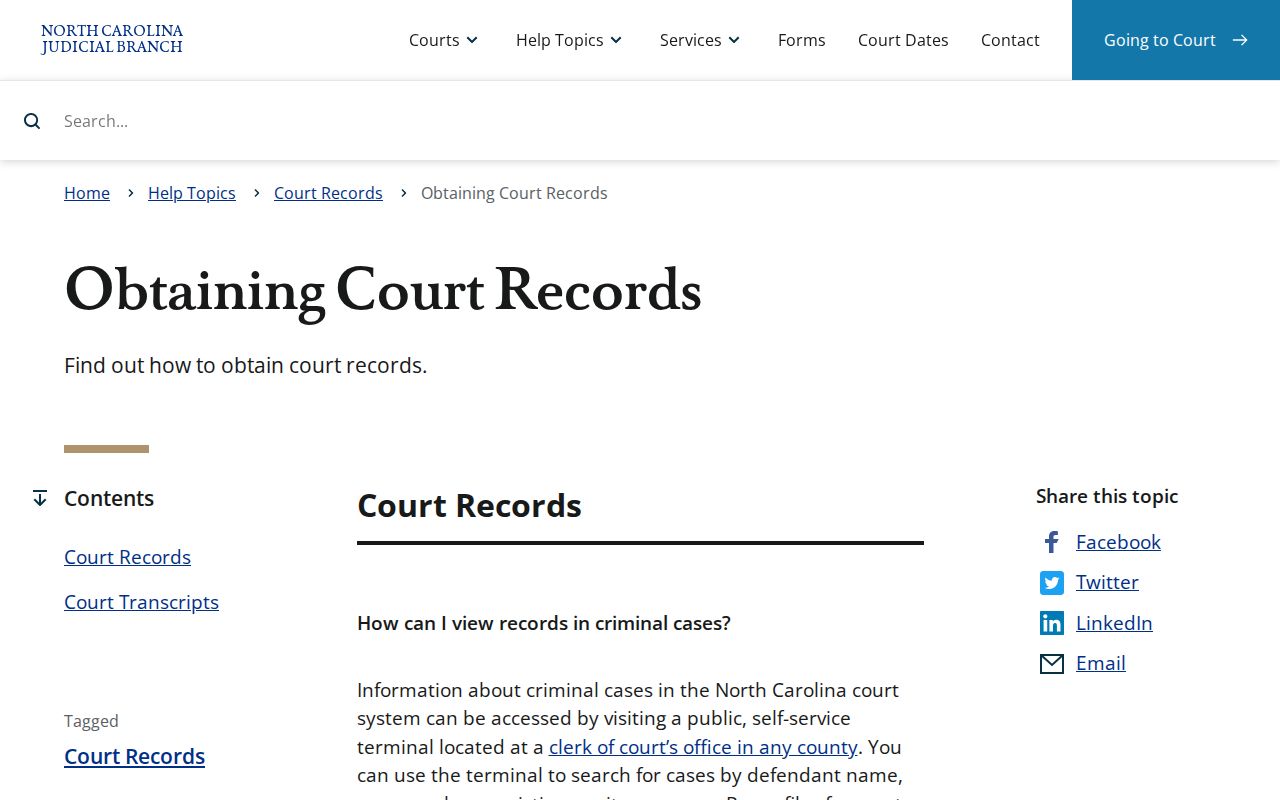
The court source supplies legal context; the Sheriff or NCDAC remains the source for the physical custody event.
Find Released Richmond County Inmates
Start with the last known custodian. Richmond County Jail, an NCDAC prison, and a federal or immigration agency do not share one complete release database. Keep the full name, alternate spelling, approximate booking date, and any booking, case, offender, or register number. These identifiers reduce same-name errors.
- Check the Sheriff’s current portal only to see whether the person is presently listed in Richmond custody. A negative result is not a release certificate.
- Try the county released route, knowing that it redirected to current-inmate pages during research. If it fails, request the booking-release event.
- Search NCDAC Offender Public Information when state prison or state supervision may apply. Read status with sentence and movement history.
- Check eCourts for the disposition and NC SAVAN or VINELink for a reported custody change.
- Use BOP or ICE only when federal or immigration custody is relevant. A transfer must be followed into the receiving system.
A released person usually leaves a current-custody roster. Absence can also result from transfer, spelling mismatch, delay, correction, or another booking status.
A useful confirmation combines identity, agency, and event. Match the booking, offender, case, or register number before relying on a same-name result. Then record what the source actually says: admitted, active inmate, released, inactive, transferred, on supervision, or no longer in that agency’s custody. Do not turn one status into another. An NCDAC inactive profile may describe a release years ago, while a VINELink alert may report a new agency event. A court dismissal may remove one custody basis even though a second case or detainer remains. When the sources conflict, prefer the Sheriff’s record for the county-jail release time, NCDAC movement history for state imprisonment, and the filed judgment for the legal disposition.
NCDAC Search for Richmond Releases
The NCDAC Offender Public Information search covers North Carolina prison and community-supervision records. Its general form accepts status, name, offender number, sex, race, ethnicity, birth-date range, and age range. The offender number is numeric and may contain up to seven digits. A “sounds like” last-name option can help with spelling.
| Search control | Best use |
|---|---|
| Inactive status | Find historical state-system records, then read actual release or movement entries. |
| Active inmate | Confirm current NCDAC confinement. |
| Active Probationer/Parolee | Check public state supervision status without guessing the supervision type. |
| Offender number | Separate people with similar names. |
| Name, birth date, age | Narrow a search when an offender number is unknown. |
The separate NCDAC Inmate Release Search uses release county, year, and month together or a partial last name. It is a monthly state-prison release archive. It is not Richmond County Jail’s daily discharge list.
An inactive result needs close reading. Review every sentence and movement panel for the actual release date, later supervision, and more than one commitment. A transfer to another NCDAC institution is still custody. If the detail changes from prison status to active supervision, the person has left prison but has not necessarily completed the broader correctional term. The Richmond County Sheriff cannot resolve a state sentence calculation or confirm the end of NCDAC supervision. Conversely, NCDAC cannot supply the earlier local booking-release file merely because the county case led to a state commitment.
The official search screen shows the available status and identity controls.
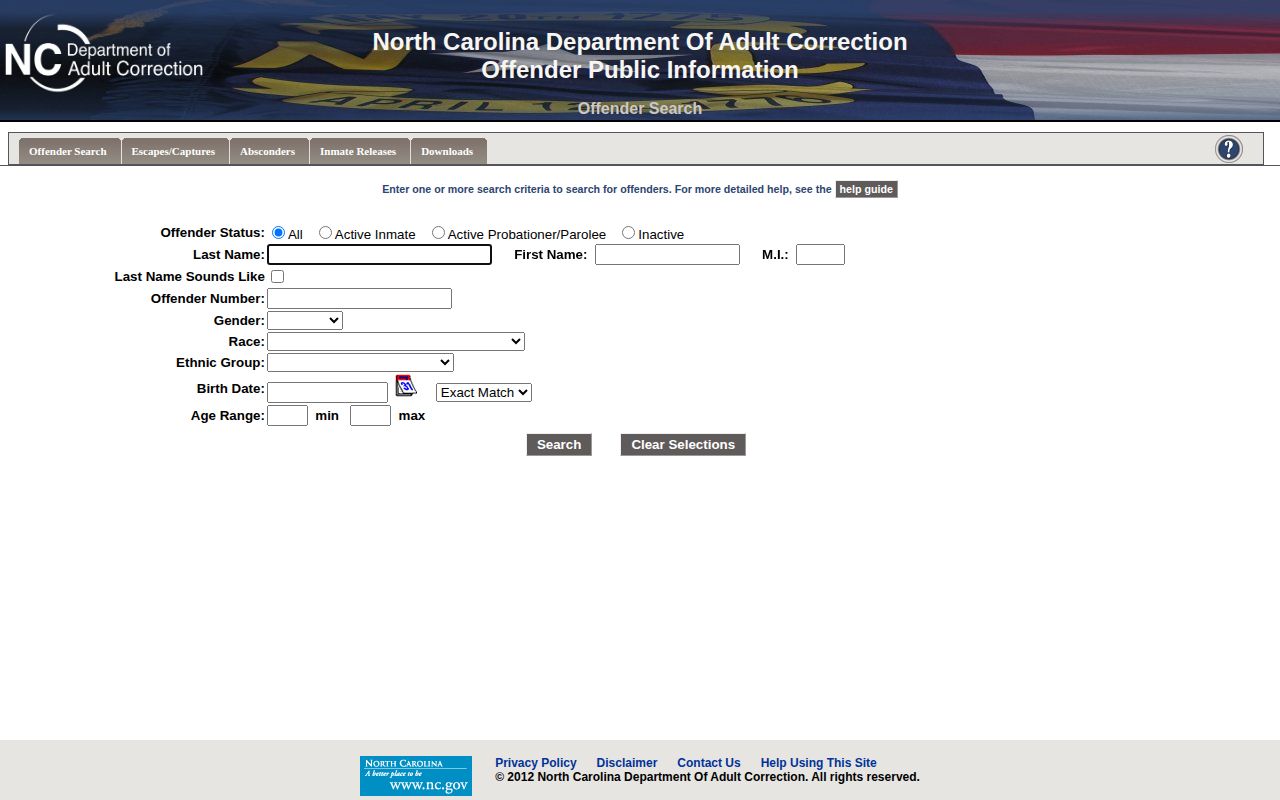
Open the matched detail and compare the offender number, sentence, location, and movement history before calling an inactive record a release.
Richmond County Recent Release Limits
The Sheriff’s inmate-information page describes charge and bond information for people detained at Richmond County Jail. That makes its ordinary portal a current-custody tool. Separate released-search and released-grid routes exist in the system, with fields for name, admission, release, time in jail, charge, and court type. Both redirected to current-inmate routes when rechecked July 30, 2026. They should not be promoted as stable public 24-hour or 72-hour feeds.
For same-day context, the 24-hour release-list process must lead with the official fallback. No official Richmond Sheriff app was located, no cadence or web-retention promise was published, and the transient grid count is not a release statistic. Request the event, use SAVAN for notices, and compare the court case.
Richmond County Post-Release Supervision
A prison release can lead into supervision rather than the end of all correctional control. NCDAC Community Supervision handles field supervision, while the North Carolina Post-Release Supervision and Parole Commission makes decisions within its authority. Detailed probation files are confidential under state law, but OPI can show a public active supervision status and supervising jurisdiction where available.
Probation is a court-imposed community sentence or component. Parole is conditional release under parole-eligible sentence law. Post-release supervision follows imprisonment under Structured Sentencing. An absconder listing indicates alleged noncompliance and continuing state interest, not completed discharge. Public OPI status and the responsible state agency provide the verification path.
Richmond County Reentry After Release
Richmond County’s Local Reentry Council appears in the county’s members, partners, and resources list. An April 2026 county agenda packet describes coordination around basic needs, transportation, identification documents, health and treatment connections, and other reentry concerns. Richmond Community College’s Building Brighter Futures work also addresses reentry programs and people who have recently returned from custody.
That newer council activity updates a 2022 community assessment that found local jail-reentry initiatives lacking at that time. The partner list is a navigation point, not a promise that any one service is available to every person. Confirm eligibility and current intake directly with the named provider.
Richmond Release Alerts and Transfers
North Carolina’s SAVAN program uses VINELink for public custody search and notification registration. It can report events supplied by county jails and NCDAC. A release or custody-change alert should be preserved with the reporting agency and timestamp, then checked against the Sheriff record or NCDAC history. It does not rule out transfer, a detainer pickup, or supervision.
For federal imprisonment, use the Bureau of Prisons Inmate Locator. A past BOP release date with no listed facility can confirm the end of BOP custody for the matched register number, but not the end of supervised release or a later local hold. A federal pretrial detainee may instead require the federal docket and confirmation from the actual holding facility. If the Sheriff reports transfer to ICE, use the ICE Online Detainee Locator and describe the event as transfer from Richmond custody. No official source reviewed established that Richmond County operates an ICE contract or 287(g) program.
The North Carolina Sex Offender Registry is a separate, narrow channel for people who have a legal registration duty. A registry result can confirm a public registration record, not the date or type of jail or prison release. It must not replace the Sheriff record, NCDAC history, or a SAVAN notice.
Search Morrison and Richmond Records
Richmond Correctional Institution was called Morrison Correctional Institution until October 4, 2021. Historical judgments, news items, and movement records may still use the Morrison name. Searching both names can reconcile an older state-prison record. The rename itself was not a transfer or release, and it did not turn the prison into a county facility.
Richmond Custody and Release Sources
Each system answers a narrower question. Match the source to the population before drawing a conclusion.
| Source | Population | What it can confirm |
|---|---|---|
| Sheriff current portal | People presently reported at Richmond County Jail | A positive current-custody record; absence alone is inconclusive |
| Sheriff release record | Richmond County jail bookings | End of that booking, release time, and destination when public |
| NCDAC OPI | State prisoners and state-supervised people | Status plus sentence and actual movement or release history |
| VINELink | Events reported through NC SAVAN | Prompt custody-change notice tied to the reporting agency |
| eCourts and Clerk | North Carolina court cases | Order, judgment, or disposition; not the physical release time |
| BOP or ICE | Relevant federal or immigration populations | Agency-specific custody result, with scope limits |
Richmond County Release Facilities
Richmond County Jail holds county detainees and records the end of a Richmond booking, whether the person returns to the community or goes to another authority. Richmond Correctional Institution is an NCDAC state prison at Hoffman. Its completed prison releases and movements belong in state correctional history.
- Richmond County Jail: confirm the county release event with the Sheriff and court case.
- Richmond Correctional Institution: confirm state release or transfer through NCDAC OPI.