
Richmond County Jail Release Paths
Richmond County Jail is the Sheriff-operated county detention facility for pretrial detention, short county sentences, and agency holds. A booking can end in several ways. A person may return to the community after meeting bond terms, after a dismissal or court order, or after serving a county sentence. The jail may also relinquish custody to the North Carolina Department of Adult Correction, another county, the federal government, immigration authorities, or another lawful custodian. That last event is a transfer. It is not a release to the community, even if the Richmond booking has closed and the person no longer appears in the local current-custody portal.
The most useful proof is the Sheriff’s booking-release event tied to the right booking. Compare it with the court case when the legal reason matters. A court order can explain a dismissal, bond action, sentence, or time-served judgment, but it does not give the exact time when jail processing ended. Likewise, a current roster can show continued detention, yet a negative search is not a release certificate. The full Richmond County search and record path is set out on the Richmond County released-inmate search.
Confirm Richmond County Jail Releases
The Sheriff’s inmate-information page says its public information concerns charges and bonds for people detained in the jail. Use that channel to check present custody. Richmond’s detention portal has a separate released-record design, but its released routes redirected to current-inmate pages during research. It should not be presented as a stable daily release search. A missing current result is only the start of the check.
Use a tight sequence so that names, bookings, and custody events do not get mixed:
- Search the Sheriff’s current portal with the full name and a second identifier, if lawfully known. Try a middle name or alternate spelling before deciding the record is absent.
- Preserve the known booking date, booking number, charge, or case number. These details help the records custodian isolate the right Richmond County Jail release event.
- Ask the jail for the admission and release date and time, release authority or type, and receiving agency if the person was transferred.
- Check the Richmond County court case for a bond entry, dismissal, judgment, commitment, or time-served order that may explain the legal basis.
- If the Sheriff identifies NCDAC or another custodian, switch to that agency’s official locator. Do not keep treating the closed county booking as a community release.
North Carolina SAVAN and VINELink may supply a prompt custody-change notice for a named reporting agency. The notice can support the timeline, but the Sheriff record remains the durable local document. A notice may also reflect a transfer or a release followed by state supervision. Confirm the event type when the destination matters.
Note: Record the source, exact field label, event date, and date checked so later updates do not blur the original result.
Richmond County Jail Release Records
The dormant released-record model shows why a focused request is more useful than asking only whether someone is “out.” Its observed grid fields include identity data, admission and release dates, time in jail, the primary charge, and the court type tied to that primary charge. The list did not show a release reason. A short stay does not prove bond release, and a primary charge is not always the only charge. Ask for the event and its authority instead of drawing a conclusion from the length of stay.
| Record item | What it helps confirm |
|---|---|
| Full name and booking identifier | Connects the release event to the correct Richmond booking. |
| Admit date and time | Identifies the custody period that ended. |
| Release date and time | Records when the jail relinquished custody. |
| Release authority or type | Distinguishes bond, court action, sentence completion, or another disposition. |
| Receiving agency | Shows whether the event was a transfer rather than community release. |
| Charge and case number | Links the booking event to the court file and judgment. |
North Carolina public-records law provides the framework for requesting public agency records, while criminal investigation material can have access limits under G.S. 132-1.4. Ask the custodian to identify any redacted or withheld item and the legal basis. No Richmond-specific release-record form, copy rate, or promised turnaround was found. Request an estimate rather than assuming a fee or completion date.
The official criminal-record access provision is also the source behind this matched view:
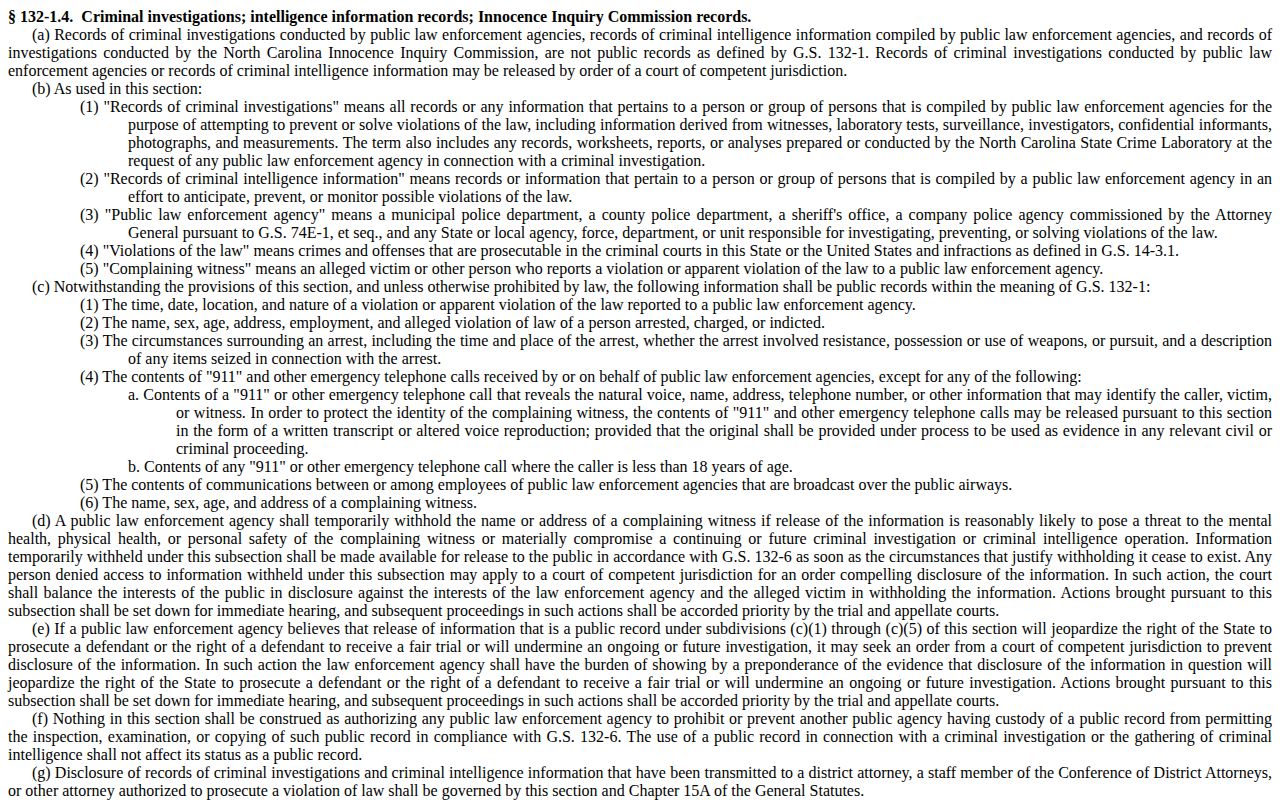
The statute view reinforces a key limit: public booking information and investigative material are not the same record category.
Richmond County Jail Release Contacts
The Jail Administrator is the direct local fallback when the released interface cannot be used. Give enough detail to distinguish the booking, then ask for a specific set of fields. A request framed around the admission, release, disposition, and receiving custodian is easier to route than a broad request for everything about a person.
Richmond County JailJail Administrator, Captain David Wall
1 Court Street
Rockingham, NC 28379
Phone: 910-997-8248
Fax: 910-997-8387
The Sheriff’s main office is at 114 E. Franklin Street, Suite 105, Rockingham, NC 28379, and its phone number is 910-895-3232. The official Jail Division page supplies the facility contact and identifies the administrator. No published release-processing hours, weekend or holiday rule, exit location, family waiting area, or property-return procedure was located. Call the jail for current logistics rather than relying on a routine from another county.
The official facility page is shown in the matched capture below:
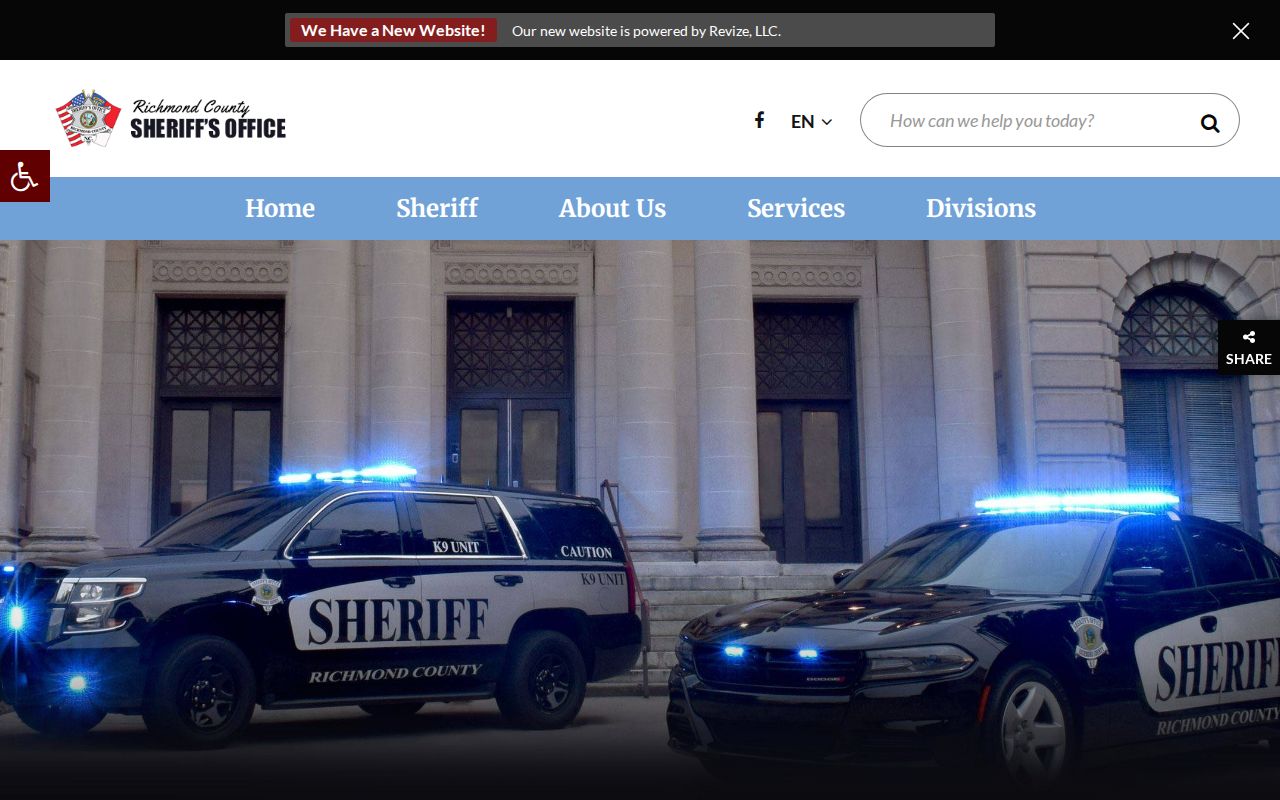
That source is the appropriate place to recheck the administrator and jail contact before sending a request.
Richmond County Jail Record Boundaries
The county jail and Richmond Correctional Institution are separate operations. The Sheriff controls the county booking file. NCDAC controls state-prison sentence, movement, and release history. A person who bonded out or completed a purely local jail sentence may never appear in NCDAC Offender Public Information. Conversely, someone serving a state sentence should not be searched as though still housed by the Sheriff.
If the county record shows a transfer to NCDAC, use the state offender number, status, location, sentence panel, and movement history. “Active Inmate” means the person remains in state prison custody. “Active Probationer/Parolee” can mean physical release from prison followed by supervision in the community. “Inactive” points to historical state involvement, but the underlying release entry must still be read. A transfer between NCDAC prisons is only a location change.
| Question | Correct Richmond source |
|---|---|
| Is the person detained in the county jail now? | Sheriff current-custody portal |
| How did the county booking end? | Sheriff booking-release record and court case |
| Was custody transferred to state prison? | Sheriff receiving-agency field, then NCDAC OPI |
| Did a state prison term end? | NCDAC status and actual movement or release history |
The separate Richmond Correctional Institution offender search explains the state-prison route. Keeping both systems apart prevents a county booking closure from being mistaken for the end of all custody.
Richmond Jail and Prison Records
Captain David Wall’s official biography adds a distinctive local point. Before his Sheriff career and current role as Jail Administrator, he worked at the facility then called Morrison Correctional Institution. The same biography notes his detention-accreditation advisory work and his 2025 nomination to the North Carolina Jail Administrators’ Association board. That experience crosses correctional settings, but the records do not cross with it.
A Richmond County Jail release remains a Sheriff record. A Richmond Correctional Institution discharge remains an NCDAC record. The administrator’s prior service at the state prison does not turn a county booking into a state offender entry, nor does it make the jail records office the custodian of a prison release. Historical references to Morrison concern the former name of the state institution, not a change in the Sheriff jail’s identity or authority.
This split matters most after a transfer. The Richmond County Jail record should identify that local custody ended and name the receiving authority when public. The NCDAC record then shows the state-side status and movements. Both documents can be correct because each covers a different part of the custody chain.
Note: Staff experience may cross agencies, but a release request must still go to the office that created and keeps the record.
Richmond County Jail Release Gaps
Several gaps are confirmed rather than overlooked. No stable official 24-hour or 72-hour release URL was found. The dormant arbitrary-days form could support those windows in design, yet its public routes redirected during testing. The agency publishes no cadence or display-retention promise for that interface. No official Sheriff mobile-app link was located, and no released-grid photo field was verified.
Release logistics are also unpublished. There is no verified public schedule for processing, no stated weekend rule, no named exit, and no documented family waiting process. No current local bond schedule or named pretrial release program was found. These limits call for precise questions, not borrowed assumptions. Confirm logistics directly with the jail and use the individual court bond entry when bond terms matter.
When sources conflict, prefer the Sheriff booking-release record for the physical end of Richmond County Jail custody. Prefer the filed court order for legal disposition. Keep distinct dates distinct: a court order, administrative processing, physical release, receiving-agency intake, and database update may occur at different times. Label each event instead of forcing them into one timestamp.