
Richmond County Parole vs Probation
North Carolina uses several forms of community supervision, and the labels describe different legal paths. A Richmond County resident may be physically free from a jail or prison yet remain active in North Carolina Department of Adult Correction records. The court creates probation. The Post-Release Supervision and Parole Commission has authority over parole decisions for the limited eligible population and over post-release supervision matters, while NCDAC Community Supervision officers handle field supervision.
| Supervision type | How it begins | What a public check may establish |
|---|---|---|
| Probation | A court imposes a community sentence or supervision component. | OPI may show an Active Probationer/Parolee status and public supervision information. |
| Parole | The Commission conditionally releases a person who is legally parole eligible. | OPI history and an official Commission result can help identify the parole event. |
| Post-release supervision | A statutory supervision term follows release from prison under Structured Sentencing. | A prison release may be followed by active supervision rather than an inactive record. |
Ordinary parole was abolished for offenses committed on or after October 1, 1994. Older sentences, some impaired-driving sentences, and narrow special categories can remain eligible. Post-release supervision is not a modern name for parole, and probation is not proof that the person first served a prison term.
The distinction also changes which document answers a question. A Richmond court judgment establishes a probation sentence. NCDAC OPI can show the public state-system status. A Commission report may record a parole review result for an eligible case. The Sheriff’s booking event, by contrast, records when Richmond County Jail relinquished custody. Reading those records as if they were one timeline can turn a correct date into the wrong claim.
Check Richmond County Post-Release Supervision
The official starting point is NCDAC Offender Public Information. It includes state correctional and Community Supervision histories, but it does not contain a purely county-jail booking. Use an offender number when known because it is more precise than a name. A Richmond County Jail release record remains a Sheriff record unless the person also entered state custody or state supervision.
- Open OPI and choose the Active Probationer/Parolee status filter.
- Search by the seven-digit offender number, or use the full name with birth date or age filters.
- Compare the name, offender number, identity details, conviction data, and Richmond supervision jurisdiction before choosing a result.
- Open the detail and read the status, sentence, release history, and displayed supervision type together.
- Record the exact field labels, dates, offender number, and access date rather than shortening the result to “on parole.”
- If the record is unclear, use an official NCDAC or Commission contact without asking an unverified office to receive the person.
An Active Probationer/Parolee result is an umbrella search result. It can be consistent with probation, parole, or post-release supervision, so the detail controls the description. An inactive result may show an older completed history. Read the release and supervision events before treating it as a recent discharge. For the broader county-jail and state-prison sequence, the Richmond County released-inmate search guide explains which custodian holds each record.
Note: A prison release date, supervision start date, and supervision termination date may all be different and should be labeled separately.
Richmond County Supervision Office Routing
Richmond, Anson, Stanly, and Union counties belong to NCDAC Community Supervision Judicial District 20. Research did not locate a current, NCDAC-confirmed Richmond reporting-office address or direct telephone number. Rockingham County is a different county and must not be substituted merely because Richmond County’s seat is the City of Rockingham. For office routing, use the official NCDAC Community Supervision channel.
The image below comes from the official Community Supervision overview.
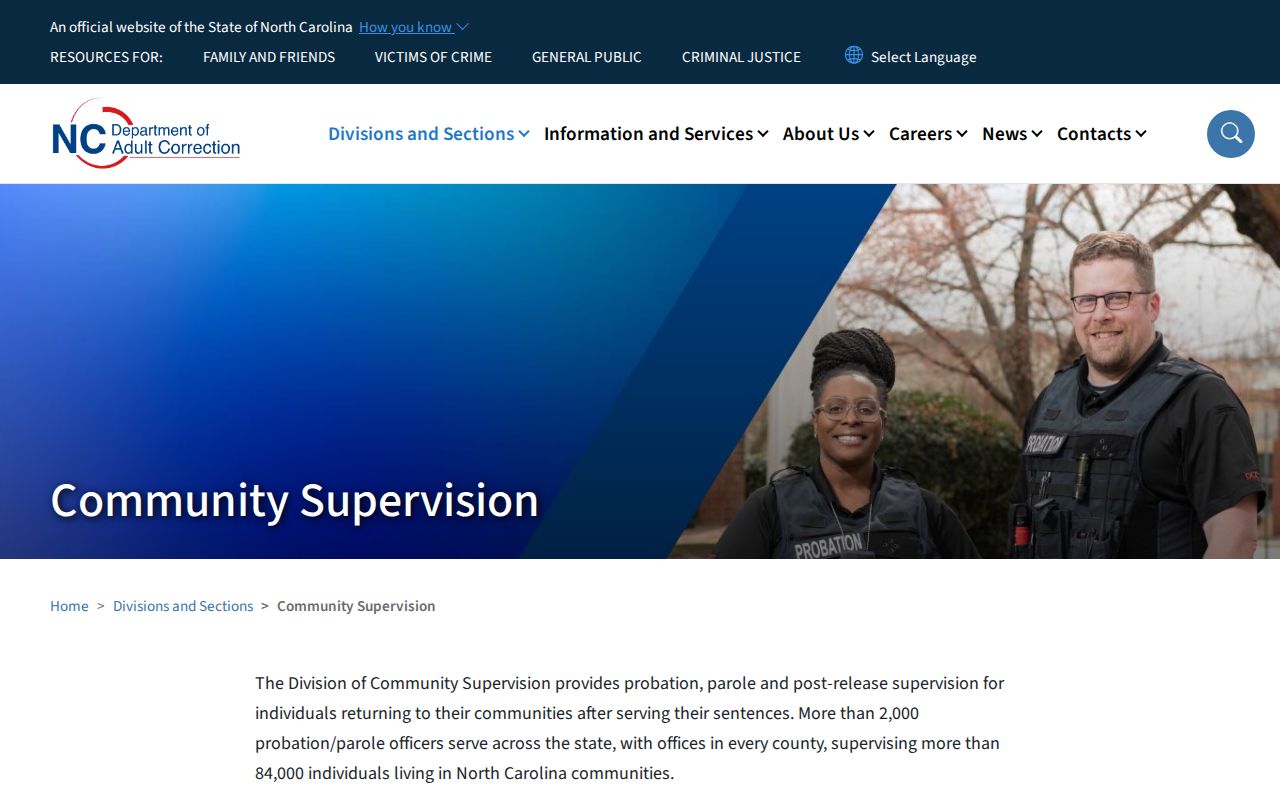
That state page is the verified routing source; it does not justify publishing a Richmond reporting-office address that NCDAC has not confirmed.
Post-Release Supervision and Parole Commission
2020 Yonkers Road, Raleigh
4222 Mail Service Center
Raleigh, NC 27699-4222
919-716-3010
Fax: 919-716-3987
Parole.Commission@dac.nc.gov
The Commission contact is appropriate for Commission process questions. It is not the records line for Richmond County Jail and should not be used to confirm a local booking release. Public OPI data can establish displayed supervision status, but G.S. 15-207 keeps probation, parole, and post-release-supervision files confidential within the statute’s access rules. Officer notes, check-in plans, and detailed conditions should not be expected in a public profile.
If an OPI result names a supervision jurisdiction but omits an office, report only what is shown. Do not infer an officer, address, or visit schedule. A person seeking their own official instructions should use the contact information already provided by NCDAC or obtain routing from the agency. Public lookup guidance cannot replace an individual reporting directive.
Richmond County Absconder Status
NCDAC maintains a separate Absconded Probationer Search. It can be searched by last name and county of supervision, including Richmond. Use the same identity checks as OPI because a name alone may select the wrong person. “Absconder” means the state alleges that the person stopped meeting reporting or contact duties. It is not a supervision discharge and should not be restated as a new conviction.
No separate Richmond County Sheriff warrant or absconder list was verified. The NCDAC result is therefore the documented public route for an alleged supervision absconding status. Conditions and violation decisions depend on the person’s order and confidential supervision file. Public explanations should stay at a high level: supervision can include reporting and other Commission or court conditions, and an alleged violation may lead to review, sanctions, or custody action under the governing process.
VINELink is a custody-notification layer, not a supervision-file search. An alert may report a new jail or prison custody event, but it does not explain the alleged violation or replace the absconder result. When a person is returned to custody, identify whether the Sheriff, NCDAC, or another authority reports the event before describing it.
Richmond County Parole Review Records
North Carolina does not offer a conventional parole-hearing calendar. The Commission states that it holds no formal hearings and does not meet personally with offenders during parole review. The useful schedule and results substitute is its official Monthly Discretionary Parole Reviews page, which publishes monthly reports beginning in September 2024. A report entry is a review outcome, not proof that a public hearing occurred.
The reports distinguish Incomplete Decision, Suspend Decision, Regular Parole, Community Service Parole, Early Medical Release, and 90-Day Mandatory Parole. Each term should be preserved. Incomplete Decision can mean more information or a MAPP investigation is needed; Suspend Decision can stop consideration or reflect a terminated MAPP agreement. Eligibility under G.S. 15A-1371 does not itself establish release.
Note: A monthly Commission outcome may explain parole review, while OPI movement history is needed to confirm an actual prison release event.
When Richmond County Supervision Ends
Supervision ends through the applicable termination or discharge process, not merely because a person is outside prison. Check OPI for the public status and historical entries. A profile that changes from active supervision to inactive can support a completed state-system history, but the event details still matter. Multiple sentences or supervision periods can create more than one date.
When records conflict, use the agency tied to the event. NCDAC movement history is stronger for state-prison release, the Commission record is stronger for a Commission decision, and the filed court order is stronger for a probation judgment. Richmond County Jail’s release timestamp controls the physical end of that jail booking. None of those records alone proves that every unrelated case, hold, or supervision term ended.
A formal request should be narrow. Give the offender number, record category, and date range to NCDAC, recognizing that the agency need not create a new compilation. Public basics can include conviction data, sentence length, time served, admission dates, and release dates. Confidential supervision material remains outside that public set even when a public profile confirms active or completed supervision.
Richmond County Release Reentry Network
Richmond County’s local reentry landscape has changed. A county health assessment from 2022 said jail reentry initiatives were lacking. More recent county material documents a Local Reentry Council through a 2026 proclamation and the county’s members, partners, and resources list. Richmond Community College also describes Building Brighter Futures work with reentry programs and recently released people.
This local network is a navigation resource, not part of NCDAC supervision and not a promise that any named service will be available to a given person. A supervision officer handles legal reporting duties. Reentry organizations address separate practical needs. Use the county’s current partners and resources page to identify current contacts, then confirm eligibility and availability directly.
The distinction matters after release. Community help does not replace a probation, parole, or post-release-supervision condition, and an organization cannot declare a person discharged. Likewise, a public OPI record does not describe all reentry services that may be open in Richmond County.