
Richmond County Projected vs Actual Release
A projected date estimates a future event from the sentence and the correctional system’s current calculation. An actual release entry records an event that has occurred. NCDAC Offender Public Information may display a projected release-related date, maximum expiration, post-release-supervision date, or another label depending on the sentence era and record. Preserve the portal’s wording because those fields are not interchangeable.
A pretrial detainee generally has no computed sentence-release date. A Richmond court may set or change bond, dismiss a charge, enter judgment, or issue another order, but jail processing and other holds still affect when the person leaves. For a local sentence, use the filed judgment, jail-credit information, and Richmond County Jail release record. For a state term, use NCDAC sentence and movement history.
Release from one facility does not always mean return to the community. The event may be transfer to another jail, NCDAC, federal custody, or immigration custody. Release from prison to post-release supervision ends imprisonment but not the state correctional relationship. Sentence expiration and supervision discharge may occur later.
Find a Richmond County Projected Release Date
Begin with the last known custodian. The NCDAC offender search contains current and historical state correctional information back to 1972, but NCDAC says it does not contain county-jail information. A Richmond County booking will not appear merely because it happened in North Carolina.
- Identify whether the person is at Richmond County Jail, Richmond Correctional Institution, another NCDAC prison, or another agency.
- For state custody, search OPI by the seven-digit offender number when known. Otherwise use name and limited identity filters.
- Match the offender number, birth or age data, conviction, status, and location before reading any date.
- Open the detail and compare the sentence, commitment, movement, release, projected-date, and maximum-expiration panels.
- Record the exact field label and date plus the date accessed. Do not rename a maximum date as a scheduled release.
- For a Richmond local sentence or pretrial booking, obtain the court judgment or bond entry and ask the Jail Administrator for the booking-release event.
NCDAC’s dedicated Inmate Release Search is a monthly historical state-prison release tool. Its Richmond county selector is not a daily list from Richmond County Jail, and “release county” should not be assumed to mean county of conviction or prison location. The general Richmond County release lookup covers the full records-request and court path for a named person.
The image below comes from the official NCDAC offender-search form.
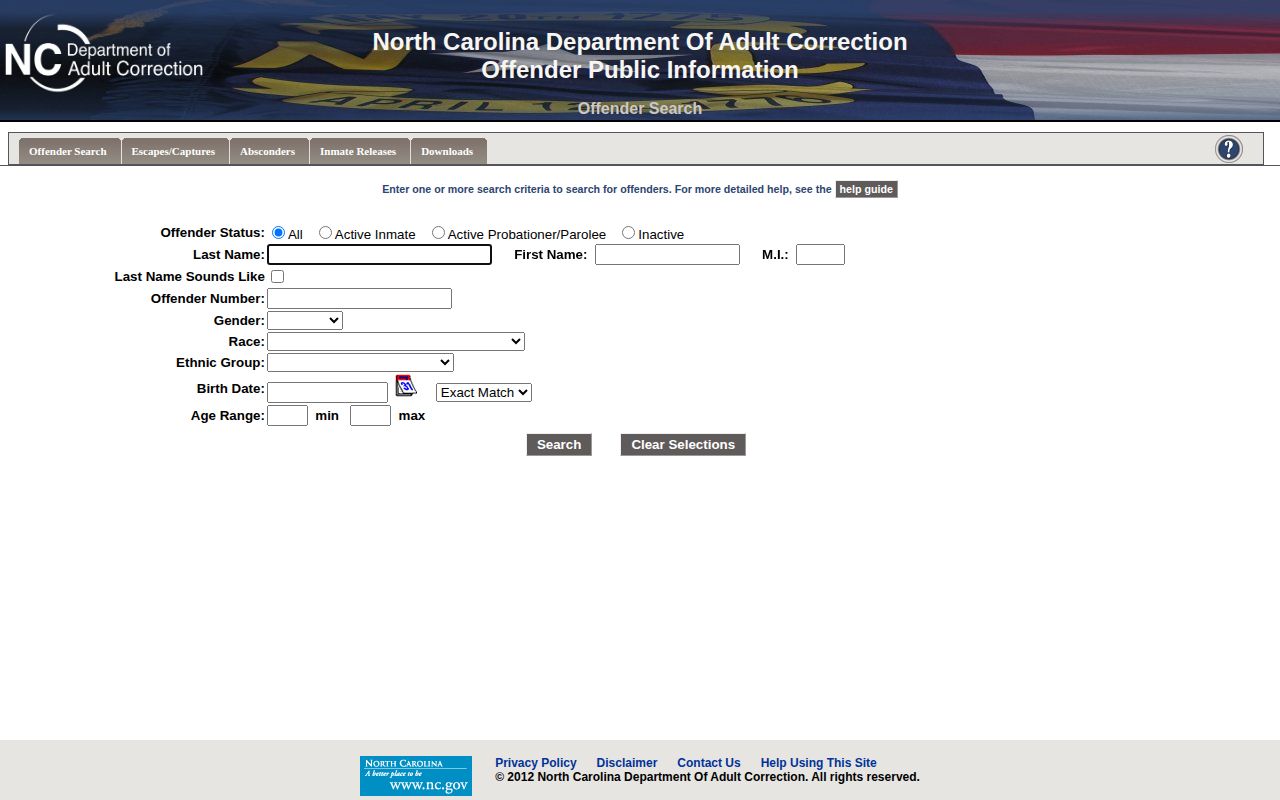
The form’s status and identity controls support the first match; the selected offender detail must then supply the relevant release-related field.
Note: A current jail-roster absence cannot supply a projected or actual release date because transfer, search mismatch, and delayed updates remain possible.
North Carolina Earned-Time Release Calculations
Sentence era comes first. Structured Sentencing generally applies to offenses committed on or after October 1, 1994. Older Fair Sentencing and parole-eligible cases can use different credit and eligibility rules. Under G.S. 15A-1340.13(d), an active offender must serve the judicially imposed minimum. Credits can reduce the maximum term but cannot move confinement below that minimum.
G.S. 148-13(a1) authorizes NCDAC rules for earning and forfeiting credits, including covered activated local sentences. NCDAC explains that Structured Sentencing prison work or full-time program assignments can create earned time. A transfer, discipline, assignment end, or program completion can change the credit position. In older Fair Sentencing cases, gain time, good time, and merit time can apply under their own rules.
North Carolina does not have one universal rule that every person serves 85 percent. That phrase is a rough shortcut drawn from some Structured Sentencing minimum and maximum relationships. It does not replace the actual minimum, maximum, sentence class, credits, sentence grouping, post-release term, or sentence era. A reliable explanation begins with the judgment and uses the live NCDAC calculation for the matched state record.
G.S. 15A-1340.17 supplies felony grids and maximum-term calculations, but the grid alone cannot answer a person-specific release question. The imposed judgment, offense date, sentence class, concurrent or consecutive treatment, and correctional credits must agree. Older Fair Sentencing records deserve special care because a modern Structured Sentencing explanation may not fit their gain-time, good-time, merit-time, or parole framework.
Why Richmond County Release Dates Change
A projection changes when an input to the calculation or the governing legal record changes. The direction is not always earlier. A credit award or restored credit may affect one part of the term, while forfeiture, a corrected judgment, or another sentence may move the event later. Compare a saved field label and access date with the current profile instead of assuming that one source made an error.
| Factor | Possible effect on the date | Best record to check |
|---|---|---|
| Work or full-time program assignment | May create earned time under NCDAC rules while the qualifying assignment continues. | NCDAC sentence calculation and current profile. |
| Discipline or credit restoration | Forfeiture or restoration can alter the credit position. | NCDAC calculation; detailed internal material may be confidential. |
| Transfer or assignment change | May end a credit-producing assignment without ending custody. | NCDAC movement and sentence history. |
| Court correction, appeal, or resentencing | Can change the controlling term, jail credit, or sentence structure. | Filed judgment or order and updated NCDAC record. |
| Concurrent or consecutive sentences | Changes how multiple terms combine. | Judgments and NCDAC sentence panels. |
| Detainer or other hold | May cause custody to pass to another agency even when one term ends. | Releasing agency record and receiving-custodian confirmation. |
A parole decision matters only in a parole-eligible case. Eligibility is not a grant, and a monthly Commission review result should not be converted into an actual release date. For Structured Sentencing, post-release supervision follows the statutory framework rather than a discretionary parole calendar.
Other legal changes can matter as well. An appeal, corrected commitment, resentencing, or change in law may alter what NCDAC must calculate. If the public date moves, compare the current judgment and profile before assigning a reason. Internal disciplinary or classification details may be confidential even though the resulting public release-related field is visible.
Richmond County Release Into Supervision
North Carolina’s post-release framework explains why a prison-release date can precede maximum expiration. G.S. 15A-1368.2 generally structures release to post-release supervision at maximum minus 12 months for Class B1 through E, maximum minus nine months for Class F through I, and maximum minus 60 months for specified sex-offense maximums, less applicable earned time. The sentence and statutory category control.
This event is release from imprisonment into supervision, not the end of the sentence relationship. OPI may then show the person as an Active Probationer/Parolee. Read the detail to determine whether the displayed supervision is post-release supervision, probation, or parole. A top-line active status cannot supply that distinction by itself.
Detailed supervision files are confidential under G.S. 15-207. The public record can establish a displayed status and selected history without exposing officer notes, reporting instructions, or every condition. No current NCDAC-confirmed Richmond reporting-office address was found, so an unverified local address should not be used.
Richmond County Jail Release Timing
A county-jail date uses a different channel. For a local sentence, compare the Richmond judgment, the credited time, and the Sheriff’s eventual release event. The NCDAC public profile is not the place to calculate an ordinary pretrial stay or a purely local Richmond County Jail term unless that sentence entered a covered state system.
No official Richmond publication established a weekend-release rule, local good-time policy, public processing timetable, release exit, or family waiting procedure. Those gaps rule out a promise about the hour or even the operational details of release. Ask the Jail Administrator for the current release record and logistics. The public released-mode portal also redirected during research, so it cannot be treated as a stable date calculator.
The dormant released model does demonstrate why an actual county record is useful. Its observed fields included admission date, release date, time in jail, primary charge, and court type, but the grid did not show a release reason. A short stay cannot be translated into “bonded out,” and a court dismissal cannot supply the physical release time. Request the release authority or disposition alongside the timestamp.
For Richmond County Jail, direct questions to the Jail Administrator at 1 Court Street, Rockingham, NC 28379, 910-997-8248. No release-record-specific form, local fee, or fixed turnaround was published. Chapter 132 calls for access as promptly as possible and allows lawful copy or special-service charges, so request an estimate before authorizing material work.
Confirm a Richmond County Release Date
As a projected date approaches, save the exact OPI label, date, and access date. On and after that day, look for an actual movement or release event. If the status changes to active supervision, describe release from prison and continuing supervision as two linked facts. If the person remains an active inmate, use the updated NCDAC record rather than asking the Richmond Sheriff to explain a state sentence calculation.
NC SAVAN and VINELink can send a custody-change notice for reported county-jail or state events. The Richmond County VINELink check explains one-person search and notification registration. A notice is timely evidence from a reporting agency, not a certified historical record. Confirm county release with the Sheriff and state release with NCDAC.
When dates disagree, label what each one means: court order, administrative processing, projected release, physical release, database update, supervision start, or sentence expiration. Do not silently choose one. For an official legal record, obtain the filed order from the Richmond Clerk or the correctional record from the agency that made the event.
Note: Transfer to another prison or custodian is continued custody even when the person has left the Richmond County facility shown earlier.